


One of the recurring themes from armchair macro strategists (armchair in this case means they just comment - they don’t actually do anything) is that the current rise of populist right has everything to do with income inequality. Its a powerful argument, and one I am sympathetic to. When we look back at the rise of socialism and fascism in the 1930s, we see these too were born in era of high income inequality.
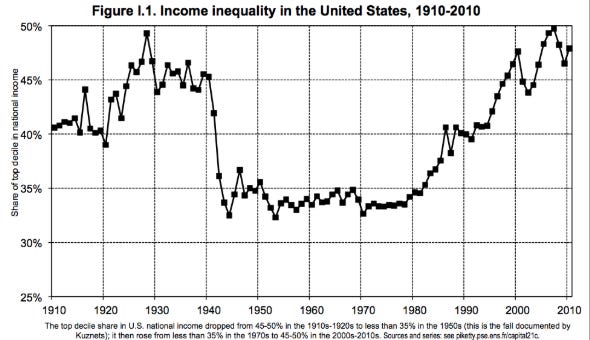
But much of income inequality came from unequal access to technology. Both within societies and between societies. Socialism and communism were both committed to breaking down the barriers of access to technology. The old feudal, agricultural societies of Russia and China were remade by the technological change that socialism and communism did so much to foster. It must be remembered that colonialism often sought to keep colonies from industrialising - that is to keep technology at home. Communism (and todays China) put great store in industrial production and technological transfer - and were (are) profoundly anti-colonial and anti-imperialism.
In a way I am arguing that the political process responds to technological/industrial advances. The industrial revolution and the French revolution did not occur at the roughly the same time randomly. Likewise the Meiji Restoration in Japan also was driven by technological change. At the heart of the Meiji Restoration was the realisation that a samurai led feudal society needed to be replaced by an industrialist led society, but industrialists had traditionally been well below the rank of samurai. A new social order was needed for Japan to progress technologically.
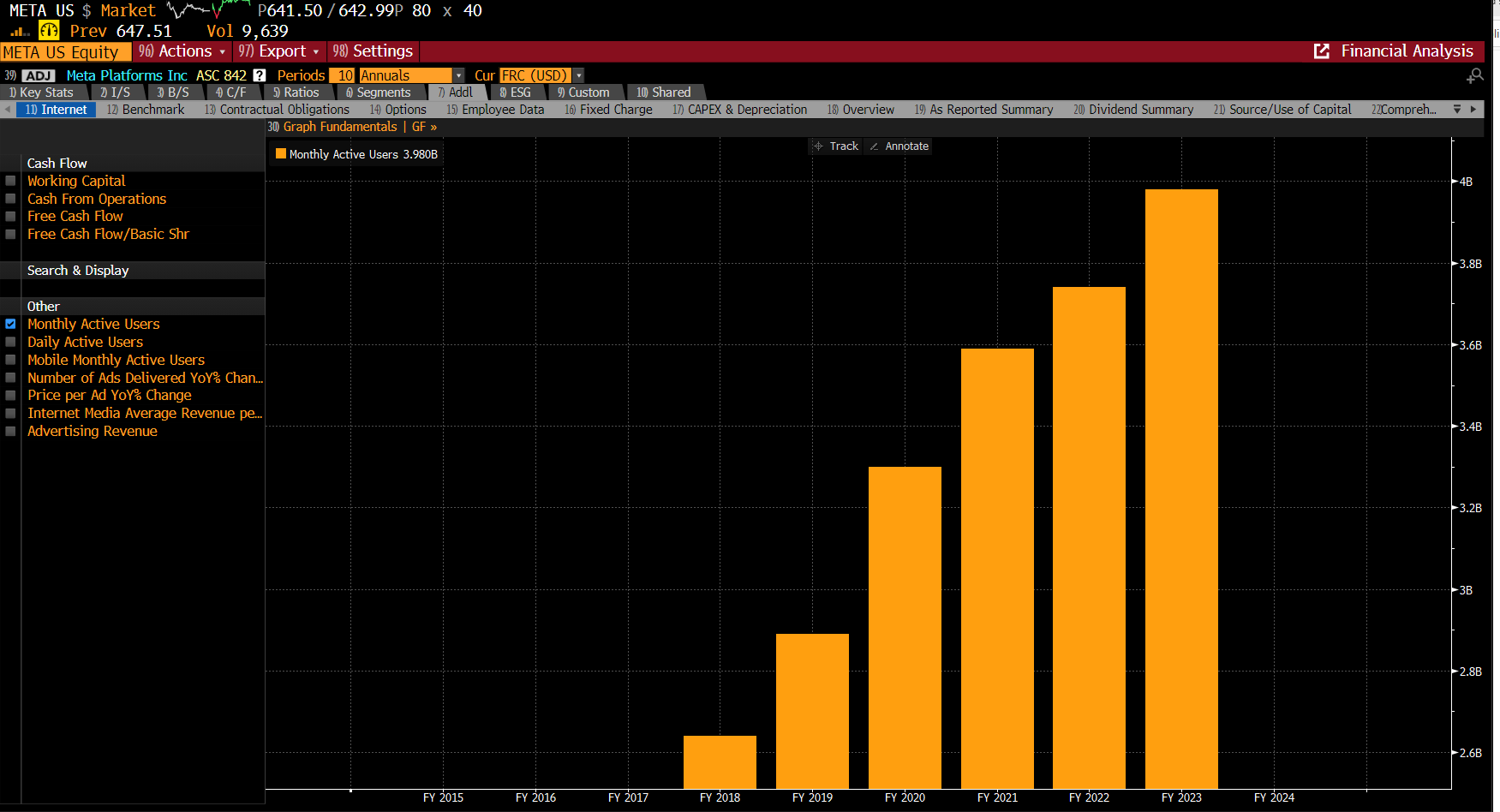
Using this logic, can we look at the rise of “right wing populism” as a response to technological changes? It is impossible not to notice that “populists” either left or right wing tend to do better. And that populists tend to better on social media. Any political party that still worries about newspaper editors seems destined for the scrap heap. So what technological change has cause such fundamental change in politics? For me, it is the “deinstitutionalisation” of society. Previously mass organisation required the organising power of government, and the centralising nature of government meant that controlling government allowed you to control the message. Now almost anyone can connect with massive number of people in a direct and personal way. Clearly this is most visible in politics, where President Trump has converted his mass following on social media to political power. When Meta has 4bn monthly users, more than any single government, we can see that power has been transformed.
For me, the political change we are witnessing is very similar to the industrial change. When I started my financial career, if you wanted to be a fund manager, you needed to join a large firm. This firm would lend you both institutional credibility, and just as importantly, a sales distribution network. Fund management institutions would also help you gain access to corporates, and crucially to investment bank research. That is you needed an institution to handle a number of relationships for you to be a fund manager.
By mid 2000s, this was already breaking down, with the rise of hedge funds. Many hedge funds set up with “two guys and Bloomberg terminal”, and investment banks became increasing comfortable dealing with start up funds. Research essentially became free, and Bloomberg, and its research function Bloomberg Industries replaced the need for almost all junior analysts (a process that ChatGPT is accelerating).
On the sales side, social media and video conferencing technology has made it much easier for managers to connect directly with investors, reducing the need for a dedicated sales force. Even with Brumby Capital, I ask myself constantly is this still the right way to do things? Do I still need this institution to do this for me?
This deinstitutionalisation takes on many forms. Do I really need to listen to health authorities? I can use the internet or AI to diagnose myself. Do I really need to use a government backed financial system? I can use crypto to trade with whoever I want whenever I want. Do I need the brand loyalty of a political party? I will just vote with the candidate that I connect best with.
Credibility is not given through your attachment to an institution, but more from your presence on social media and the authenticity that people feel. Technology has made many of the old institutions unnecessary, which is creating a political void into which “populists” are filling.
The extreme end game of deinstitutionalisation would be the end of government as we know it. All functions of government would be subsumed by the private sector, and run on capitalist lines. I think this unlikely, as ultimately at the ballot box, the majority would eventually turn on 1%, as they did in the 1930s and 40s. Also Russia’s war with Ukraine has made clear, is that the institution of an army is still necessary. Although Russia has made extensive use of mercenaries, the potential Wagner led coup highlights the limit of capitalism and defence.
What I do see happening is that government and tech are indeed merging. In China, the government has enforced strict control on the tech sector, but has protected it from outside competition. In the US, the tech sector in some ways have taken over the government, with a social media driven President largely moving policy to favour tech. The short lived DOGE was a further attempt to deinstitutionalise government.
Away from politics, when I look at sport, which I love, I cannot help notice how technology has changed sport over the years. When I was younger in Australia, rugby union and rugby league were on an equal footing. While league was played by more people, rugby union had more cache, and in particular had the pulling power of internationals against the All Blacks. However in recent years, the greater marketability of rugby league has meant that salaries have increased greatly for league players, and now Australian rugby union seems to have entered a doom loop. With the best prospects been lured to league, Australian rugby union can no longer compete with nations that only or mainly play rugby union. Why has league dominated in Australia? My best guess is that rugby league is much more watchable than rugby union, which is a theme that is visible in global sports.
Away from Australia, when I look at the most valuable sports leagues, NFL, MLB, NBA and IPL - they share one thing in common. The ability to advertise.
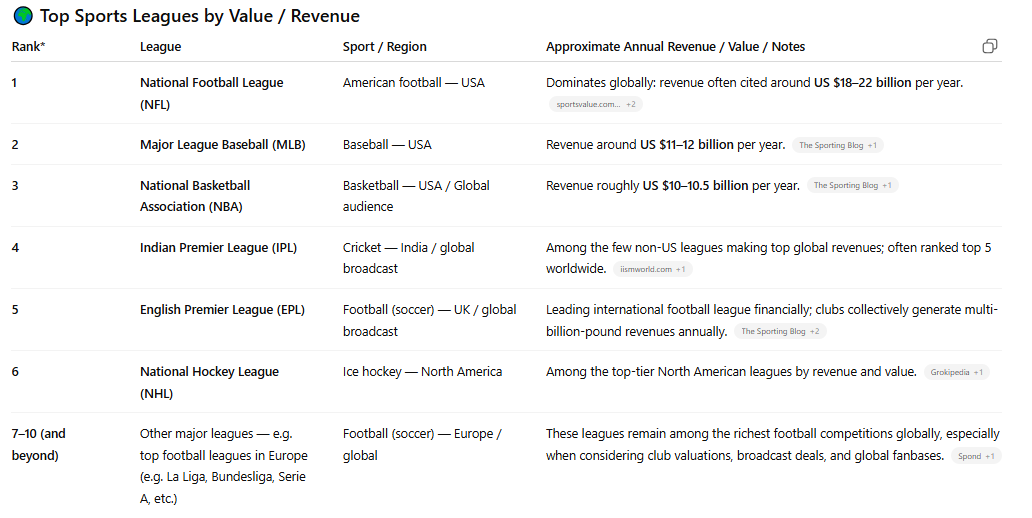
They all share a very high advertisement to actual action ratio. For my European and American readers, cricket has copious opportunity for advertisements - ever 6 balls, we see a change in bowler which takes at least a minute. Every wicket (change of batter) gives a chance for an ad break and takes at least minute, and the IPL also added in time outs as well to offer more chances for commercial breaks. The NFL is the most valuable league not because it is the most popular, but because it can sell the most commercials.

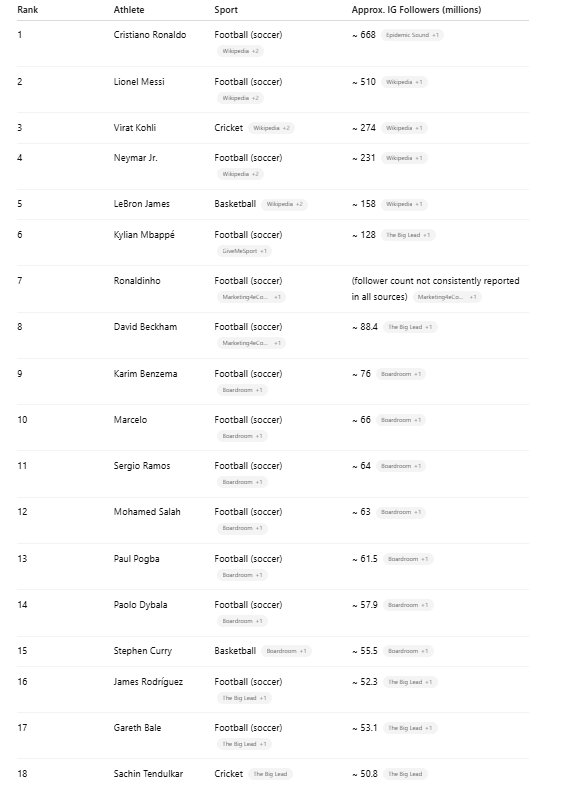
The NFL probably benefits from the lack of actually playing time in its games. It is noteworthy that very few NFL players have high number of Instagram followers. The problem for NFL players is that wearing a helmet all the time means the average punter in the street (or on Instagram) does not recognise them. This probably adds to the value of the NFL league, as players have less negotiating power. Football, basketball and cricket seems to allow its players greater connection to fans.
Dining experience has also changed with technology. With the rise of social media, it is not hard to notice that restaurants often do their best to make the food or venue LOOK good, even at the expense of taste. Certainly in London you have had the rise of restaurants that LOOK good, but taste average. Nusr-Et, Sexy Fish, Bacchanalia are just a few that come to mind. But as 51 year old, I grew up in an era before social media, so how a place looks is less important to me than how it tastes. But this is not true for the new generation - not because they are fundamentally different, but new technology has made looking good more important.
What does this all mean? Well in many ways “deinstitutionalisation” is extremely democratic. Whatever captures the attention of the most people is going to be the winning choice. It means all institutions, sporting, political, academic, financial, need to ask themselves, do we work in a “deinstitutionalised” world. Restaurants need to cater to instagrammers rather than Michelin guide reviewers. Meme stocks and meme investing have already changed finance. Sports needs to focus on watchability rather than playability (see rugby league v rugby union), and politicians needs to be popular not institutionalised. Its a new world, but not with new people, just new technology. Also it explains the constant lament of older people saying that things were better when they were younger. When in fact, they are lamenting the demise of old technologies and institutions that they themselves were helping to set up. Technology changes, but people never do.


